Last Updated: May 2026
How the Wheel Strategy Works: A Step-by-Step Breakdown
The Wheel is best understood as a loop, not a single trade. Each step has a job: choose a stock, sell a put, handle expiration, sell a call if assigned, and repeat only when the numbers still make sense.
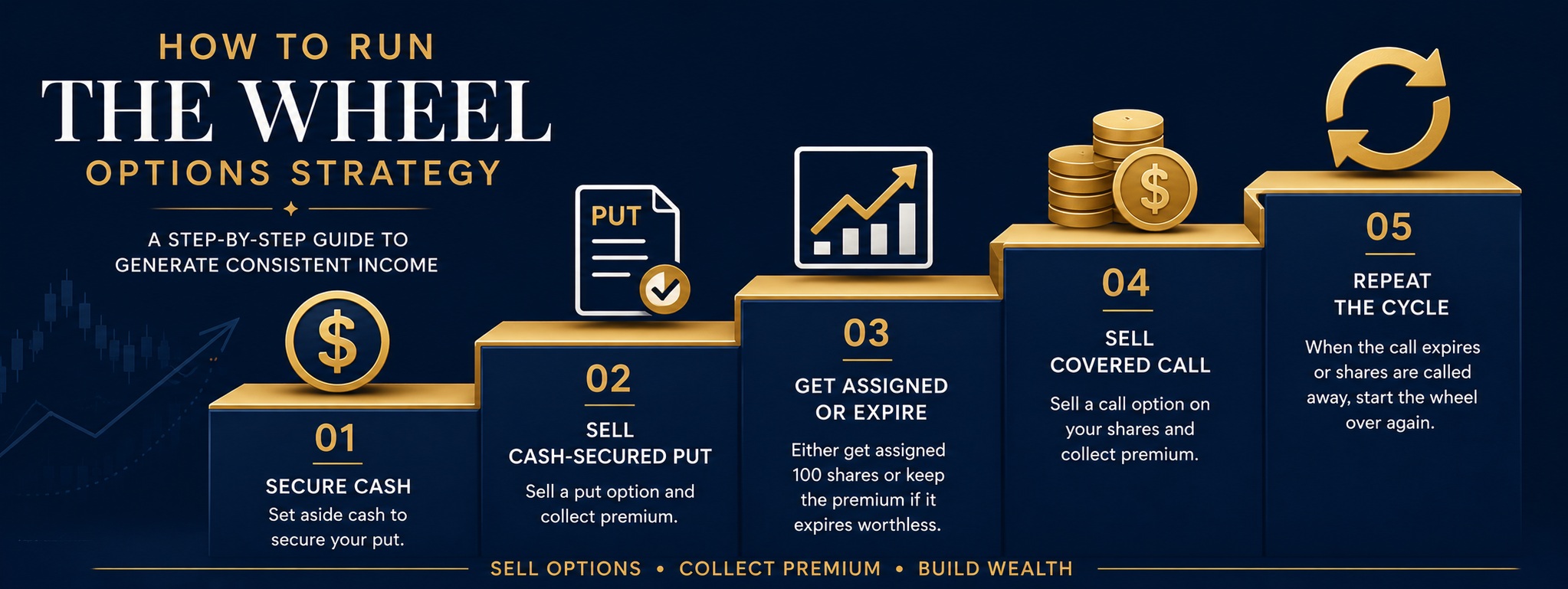
Step 1 - Choose Your Stock
Start with the underlying, because the option is only as good as the stock behind it. A Wheel candidate should be a company or ETF you would be willing to own, with liquid options, manageable share price, and no obvious binary event dominating the setup.
Many traders screen for stocks between roughly $20 and $150 because 100-share assignment is still practical. Liquidity matters as much as the ticker: tight bid-ask spreads and active open interest help you enter and exit without giving away too much edge.
Step 2 - Sell a Cash-Secured Put
A cash-secured put obligates you to buy 100 shares at the strike price if assigned. You hold enough cash to meet that obligation. Many Wheel traders choose strikes around 0.25 to 0.30 delta and expirations around 21 to 45 days to expiration, where premium and time decay are often balanced.
The premium is your compensation for accepting the obligation. It also reduces your effective cost basis if assignment happens, but it should never be treated as free money.
Step 3 - Two Outcomes After the Put Expires
If the put expires worthless, you keep the premium and can sell another put if the stock still meets your rules. If the put is assigned, you buy the shares at the strike price and move into the covered call phase.
Some traders roll puts before assignment, usually by buying back the current put and selling another one at a later expiration. Rolling is a management choice, not a rescue button; the new trade must stand on its own.
Step 4 - Sell a Covered Call on Your Shares
After assignment, the goal is to generate income from shares you now own. A covered call obligates you to sell those shares at the strike price if the buyer exercises. Many traders choose a call strike above their adjusted cost basis when practical.
Rolling covered calls can make sense when you can improve the trade for a credit, but chasing a stock upward with repeated rolls can create opportunity cost. Sometimes the cleanest outcome is to let the shares get called away and restart the cycle.
Step 5 - Two Outcomes After the Call Expires
If the call expires worthless, you keep the premium and can sell another covered call. If the shares are called away, you sell them at the strike price, keep the call premium, and return to cash for the next put sale.
The cycle is powerful because it gives every outcome a predefined next step. That structure is what separates the Wheel from improvising around a losing stock position.
How Much Can You Make?
A conservative example might use a $50 stock, requiring $5,000 of cash for one put contract. If a trader collects $50 to $100 in monthly premium, that is roughly 1% to 2% before taxes, commissions, slippage, and losing periods. Some months will be better, some will be flat, and some will involve stock drawdowns.
Results vary widely with volatility, stock selection, account size, and management decisions. The Wheel should be measured over many cycles, not judged by one perfect-looking premium.
Want the Complete Playbook?
Spin the Wheel, Cash the Checks by Logan Sterling walks you through every step of the Wheel strategy - from stock selection to trade management - with real examples and a repeatable system you can start using immediately.
View on Amazon