Last Updated: May 2026
What Is the Wheel Options Strategy?
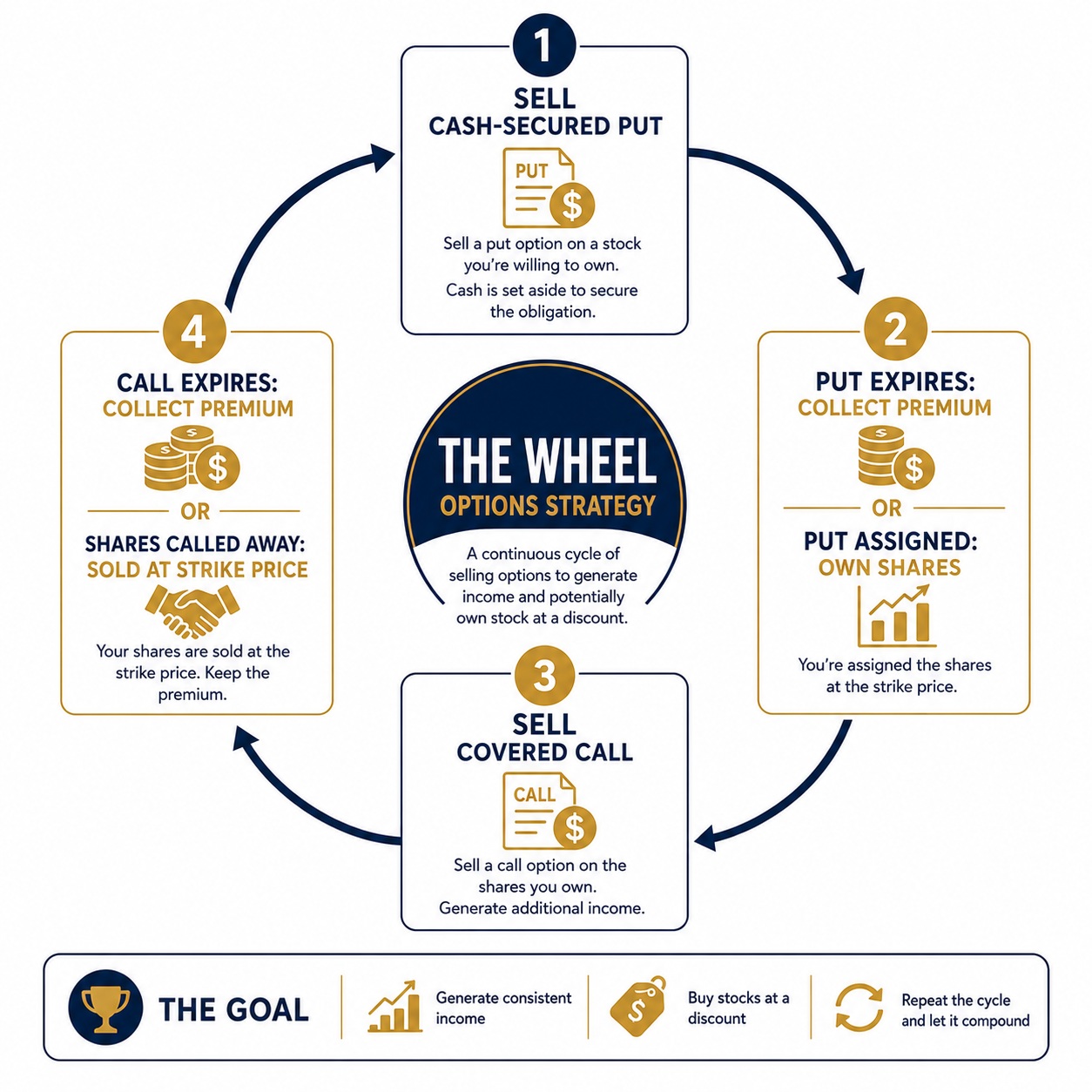
The Wheel options strategy is a repeatable process for selling options around stocks you would be willing to own. It begins with a cash-secured put, may lead to share ownership through assignment, and then uses covered calls to generate income until the shares are called away or retained.
The Core Concept - You're the Seller, Not the Buyer
Most beginners think of options as lottery tickets: buy a call, hope the stock rises, and try to sell before time decay eats the contract. The Wheel flips that mindset. You become the option seller, collect premium up front, and accept a defined obligation in exchange for that income.
Selling options does not remove risk, but it changes the nature of the risk. Instead of paying for the right to speculate, you are paid to take on an obligation you already planned for: buying a stock at a lower price or selling shares at a higher one.
The Three Phases of the Wheel
Phase one is selling a cash-secured put. You set aside enough cash to buy 100 shares if assigned and receive premium for taking that obligation. If the option expires worthless, you keep the premium and can repeat the process.
Phase two is assignment or adjustment. Assignment means you buy the shares at the strike price. Some traders roll the put to a later expiration when the thesis remains intact and the credit is attractive. Phase three is selling a covered call against the shares, collecting premium while agreeing to sell at the call strike.
Who Is the Wheel Strategy Best For?
The Wheel fits investors who prefer process over prediction. It is particularly appealing to income-seeking investors, patient traders, and people who are comfortable owning quality companies through ordinary market drawdowns.
It is not a good fit for someone who wants instant income with no drawdowns. The strategy requires cash, attention, recordkeeping, and the emotional ability to own a stock when the market is temporarily disagreeing with you.
Is the Wheel Strategy Risky?
Yes. The largest risk is the same risk that comes with stock ownership: the underlying stock can decline sharply. Premium lowers your effective cost basis, but it does not magically protect a bad stock selection or an oversized position.
Compared with simply buying and holding stock, the Wheel may create extra income and a more structured entry process. The tradeoff is capped upside while covered calls are open, assignment mechanics, tax complexity, and the need to manage options before expiration.
Ready to Go Deeper?
A good next step is to study how the Wheel works step by step, then learn the mechanics of cash-secured puts and covered calls. For a complete walkthrough with real trade examples, Logan's book Spin the Wheel, Cash the Checks covers every step in detail.